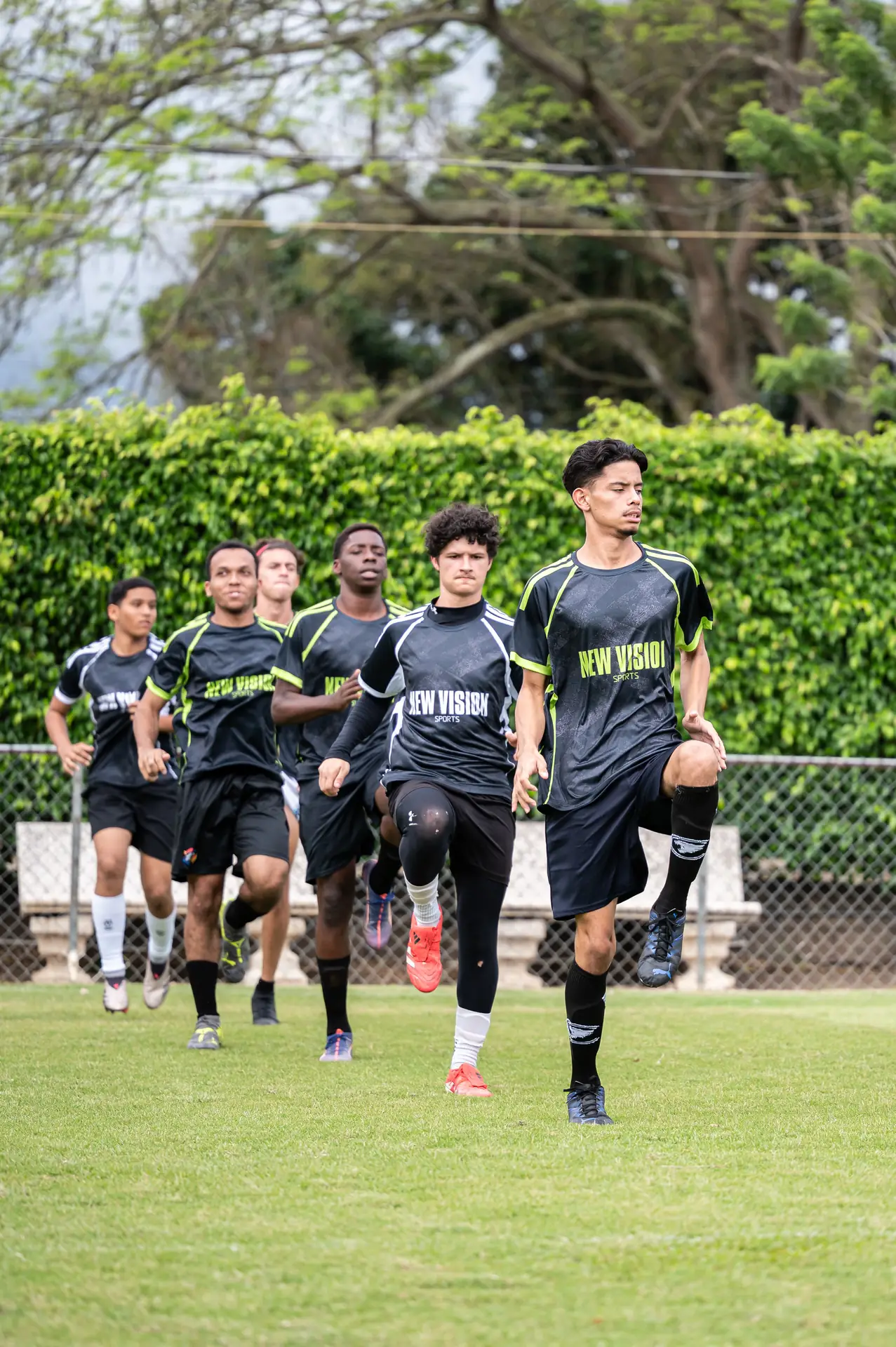
Athletic scholarships in the USA are financial awards offered by American universities to international student-athletes, covering between 28% and 100% of the total cost of studying and competing at the college level. These scholarships are granted by institutions affiliated with the NCAA, NAIA, or NJCAA, and they can include tuition, room and board, books, athletic gear, and team travel.
According to the latest official NCAA data, 554,298 student-athletes competed across the three NCAA divisions during the 2024-25 academic year — a record high — and more than 25,000 of them are international athletes. At New Vision Sports, after placing 50+ athletes from across Latin America with a 99% success rate, we see exactly how the process works from the inside: which universities actively recruit international, how much money they offer at each level, and where each profile fits. This guide compiles all of that in one place.
What are athletic scholarships in the USA?
An athletic scholarship in the USA is a financial agreement between an American university and a student-athlete. The university covers part or all of the cost of attendance in exchange for the athlete representing the program throughout their college career.
The system has three key features:
- It's an annual agreement. Most scholarships are signed for one academic year and renewed based on athletic, academic, and disciplinary performance.
- It's not only about sport. The athlete must maintain a minimum GPA and academic progress to keep the scholarship.
- It covers real costs. A full scholarship can be worth $30,000 to $80,000 per year, depending on the university.
In practice, an athletic college scholarship in the USA is what makes it possible for most Latin American athletes to study and compete at universities whose annual cost would otherwise be out of reach.
Types of athletic scholarships in the USA: NCAA, NAIA, and NJCAA
The US college sports system is divided into three main associations, each with different rules, budgets, and standards.
NCAA (National Collegiate Athletic Association)
The NCAA is the largest and most recognized association, with over 1,100 member universities and three divisions:
- NCAA Division I: The most competitive level. High-budget programs and active international recruiting. Since the 2025-26 season, under the House v. NCAA settlement, team-by-team scholarship caps have been removed and universities can offer aid to every player on the roster.
- NCAA Division II: A balance between high-level athletics and a more balanced academic life. Partial scholarships are the norm.
- NCAA Division III: Does not offer athletic scholarships, but provides academic aid and need-based financial aid that can cover most of the cost. Athletes like Gabriel Puerta (Knox College) and Ariel Ching (Centenary College of Louisiana) have reached competitive programs at this level.
NAIA (National Association of Intercollegiate Athletics)
The NAIA includes more than 250 smaller universities. It's a very real option for international athletes for three reasons:
- More flexible rules than the NCAA
- Competitive athletic scholarships (up to 12 in soccer, for example)
- More open recruiting for international profiles
At New Vision Sports we have placed several athletes in strong NAIA programs: Lenin Flores at Mid America Nazarene University, twin brothers Lucas and Sebastián Montino at Concordia University, Sofia Centella at Missouri Valley College, and David Garcés at Northwestern (NAIA).
NJCAA (National Junior College Athletic Association)
The NJCAA covers two-year junior colleges or community colleges. It's a strategic path for many Latin American athletes:
- More accessible academic and English requirements
- Full scholarships available at NJCAA Division I (up to 24 in baseball, for example)
- Smooth transfer pathway to a four-year NCAA or NAIA university after one or two years
Athletes like Alejandro Vásconez (Cecil College) and Bryer Rojas (Garden City Community College) took this route to enter the US college system on terms adapted to their profile.
Division comparison table
| Division | Programs | Scholarship type | Minimum academic level | Best fit for |
|---|---|---|---|---|
| NCAA Division I | ~350 | Athletic, full or partial | GPA 2.3 + SAT/ACT | Elite athletes |
| NCAA Division II | ~300 | Athletic, partial | GPA 2.2 + SAT/ACT | Sport-study balance |
| NCAA Division III | ~440 | Academic only | Varies by school | Academically strong athletes |
| NAIA | ~250 | Athletic, full or partial | Flexible | Smaller schools, personalized attention |
| NJCAA | ~500 | Athletic, full possible | Flexible | Academic and English adaptation |
Requirements for an athletic scholarship in the USA
To qualify for an athletic college scholarship in the USA, you must meet five categories of requirements. It's not optional to meet only some — each one acts as a filter.
1. Verifiable athletic level
College coaches need objective metrics:
- Competitive experience in federated clubs, national teams, or high-level leagues
- Metrics measured by a neutral third party (not by your club or family)
- A recruiting video of 4 to 7 minutes with your best verifiable highlights
2. Academic record (GPA)
NCAA Division I requires a minimum GPA of 2.3 on a 4.0 scale, calculated across 16 core courses in specific subjects (English, math, science, social studies). For Division II the minimum drops to 2.2. Maintaining strong grades throughout all of high school is essential — not only senior year.
3. English proficiency tests
Most universities require proof of English proficiency through one of these exams:
- TOEFL iBT: minimum 61 to 80, depending on the university
- Duolingo English Test: minimum 95 to 110
- IELTS: minimum 6.0 to 6.5
4. Standardized tests SAT or ACT
Although many universities dropped the SAT as a hard requirement after the pandemic, it is still strongly recommended for international athletes. A solid SAT score can unlock additional academic scholarships that stack on top of the athletic one and significantly lower the family's annual cost.
5. NCAA Eligibility Center registration
If your target is NCAA Division I or Division II, you must register with the NCAA Eligibility Center (or the NAIA equivalent). Without confirmed eligibility, there is no scholarship — regardless of talent.
How much does an athletic scholarship in the USA really cover?
This is the question we get most often at New Vision Sports. The short answer: it depends on the athlete's profile. But after hundreds of evaluations and real placements, we have systematized the ranges into four clear levels. This is what no other resource publishes with this precision:
The four investment levels
| Level | Athlete profile | Typical scholarship | Family pays (annual) |
|---|---|---|---|
| Elite | National team · pro exposure · elite academies | 80–100% | $0–5,000 USD |
| High | Top federated club · youth call-ups · strong competitive environments | 60–90% | $5,000–10,000 USD |
| Common | Regular federated club · solid local level · projection to develop | 40–70% | $10,000–15,000 USD |
| Special | Strong academic profile · sport as complement · mixed focus | ~28% | $15,000+ USD |
The stronger the athletic profile, the more scholarship money programs are willing to invest, and the lower the family's annual bill. The gap at lower levels typically closes as the athlete develops within the US system and renegotiates their package year over year.
For the full breakdown with target institutions per level and the exact plan we execute in each case, see our updated investment guide.
The four factors that move your budget
Every recruiting plan is built on four variables. The combination is unique to each athlete:
- Athletic level: Sets the ceiling on the offers. National team and local club generate two different universes of opportunity.
- Academic profile: GPA, English, and SAT/TOEFL unlock academic aid that stacks on top of athletic money.
- Sport and market: Some sports and positions are more saturated than others. Demand vs. supply for your exact profile matters.
- Materials quality: Highlight video, statistics, and showcase exposure are what coaches actually see. Better materials unlock better offers.
How to start the athletic scholarship process
The college recruiting process is highly regulated and different from traditional academic scholarships. These are the steps in order:
- Realistic profile evaluation. Identify your actual athletic level and the division where you can realistically compete.
- Building the athletic and academic profile. Verified metrics, season statistics, translated and apostilled transcripts, recommendation letters.
- Register with the NCAA Eligibility Center. Starting at age 15-16.
- Recruiting video. Professional production of 4-7 minutes. Best plays at the start.
- Target school list. 30 to 50 programs that recruit your position or event and match your level.
- Direct outreach to coaches. Personalized emails with video, metrics, and profile. Consistent follow-up.
- Showcases and official visits. Events where coaches can evaluate you in person.
- Sign the National Letter of Intent (NLI). The formal commitment between athlete and university.
- F-1 visa and immigration documents. Once admitted, you handle the student visa process.
Ideal age timeline
| Age | Key actions |
|---|---|
| 13-14 | Physical and athletic development, first profile evaluation |
| 15 | NCAA Eligibility Center registration, first preliminary TOEFL |
| 16 | Verified metrics, recruiting video, first coach outreach |
| 17 | Major showcases, SAT/ACT, final school list |
| 18 | NLI signing, F-1 visa, prep for move |
If you're 16 and haven't started, you're not late. If you're 17 and just starting, the pace is tighter but JUCO remains an excellent alternative. For a deeper dive on timing, read our guide on the ideal age to start the scholarship process.
Important 2025-26 changes: what other guides aren't telling you
Most articles about athletic scholarships in the USA are outdated. In 2024-25 the House v. NCAA settlement was approved, transforming the system:
- Scholarship limits removed in Division I. Previously, sports like baseball were capped at 11.7 scholarships per team. Now a university can offer aid to every player on the roster.
- Smaller rosters. D1 teams now have lower roster limits. Every spot is more valuable.
- Academics matter more. Coaches stack athletic aid with academic aid to stretch budgets.
- NIL (Name, Image, Likeness): College athletes can now earn money from their image.
Only universities that opted into the settlement (Power 5 and others) apply the new rules. Division II, Division III, and many non-Power 5 schools still operate under prior limits.
Considerations for Latin American families
The process from LATAM has particularities that Spain-focused or US-focused guides don't cover well:
- Document translation and apostille. Each country has its own process. Plan ahead.
- GPA conversion. Latin American grades are converted to the US 4.0 system. An error here can cost you eligibility.
- F-1 visa from your embassy. Requires SEVIS, the I-20 form, fees, and a consular interview.
- Cultural and language differences. The first semester is hard for every international athlete.
- Process costs. Showcases, exams (TOEFL ~$200, SAT ~$120), apostilles, and video production can add up to $1,500-$4,000 before signing the scholarship.
At New Vision Sports we work with athletes from Panama, Mexico, Colombia, Venezuela, Argentina, Costa Rica, Peru, Chile, Ecuador, Dominican Republic, and Spain. We know the academic equivalences, consular processes, and country-specific requirements.
How New Vision Sports helps
We are a Panama-based agency built by student-athletes, for student-athletes. Our team combines the experience of those who have lived the process with deep knowledge of the US college system:
- Stefano Cano, founder and CEO, leads strategy for every athlete.
- Julio Blanco coordinates academic and athletic development.
- Our scouts identify opportunities in the US and match each profile with the right coaches.
We support every stage of the process:
- Realistic evaluation of your level and the divisions where you can compete
- Recruiting video production
- Showcase and combine strategy
- Direct outreach to coaches across 500+ partner universities
- NCAA eligibility prep and legal documentation
- Continuous support through your first day of class
Today we have placed 50+ athletes at programs like Mid America Nazarene, Concordia University, Centenary College of Louisiana, Knox College, Missouri Valley College, Cecil College, Garden City Community College, Northwestern (NAIA), and Universidad Anáhuac Puebla, among others. You can see the full list of athletes and the universities we work with.
Take the next step
If you want to know where you stand today, which universities are realistic for your profile, and what your real annual budget would be, book a free 30-minute consultation or start your process here. At New Vision Sports we simplify the process: you focus on your sport, we handle the rest.